

Quick answer: what are the symptoms of a hernia?
Hernia symptoms usually start with a soft bulge in the groin, at the belly button or at an old scar, often with a dragging ache that gets worse when you stand, cough or lift. A hernia happens when part of the bowel or fatty tissue pushes through a weak spot in the muscle wall of the abdomen. See a surgeon for any new bulge, and go to the emergency room at once if it becomes hard, very painful or will not go back in.
Types of hernia, with pictures
Hernias are named after the place where they appear. A hernia of the front of the abdomen is called a ventral hernia: at the belly button it is an umbilical hernia, above it an epigastric hernia, and through the scar of an earlier operation an incisional hernia.
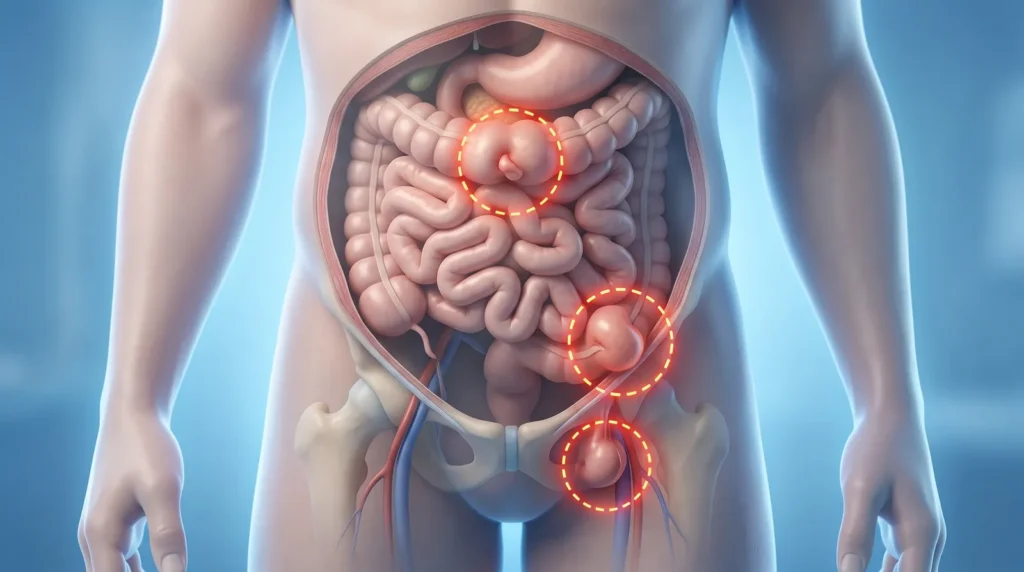
Inguinal (groin) hernia
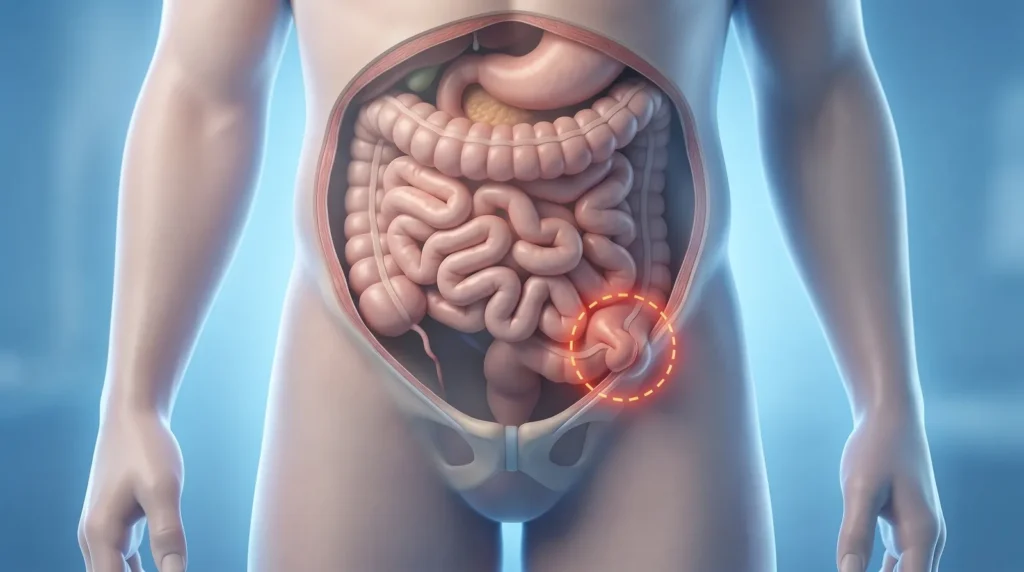
This is a bulge in the groin, just above the crease between the thigh and the abdomen, and it is much more common in men. Typical inguinal hernia symptoms are a swelling that appears when you stand and disappears when you lie down, a feeling of heaviness or dragging, and an ache or burning that is worse at the end of the day.
Femoral hernia
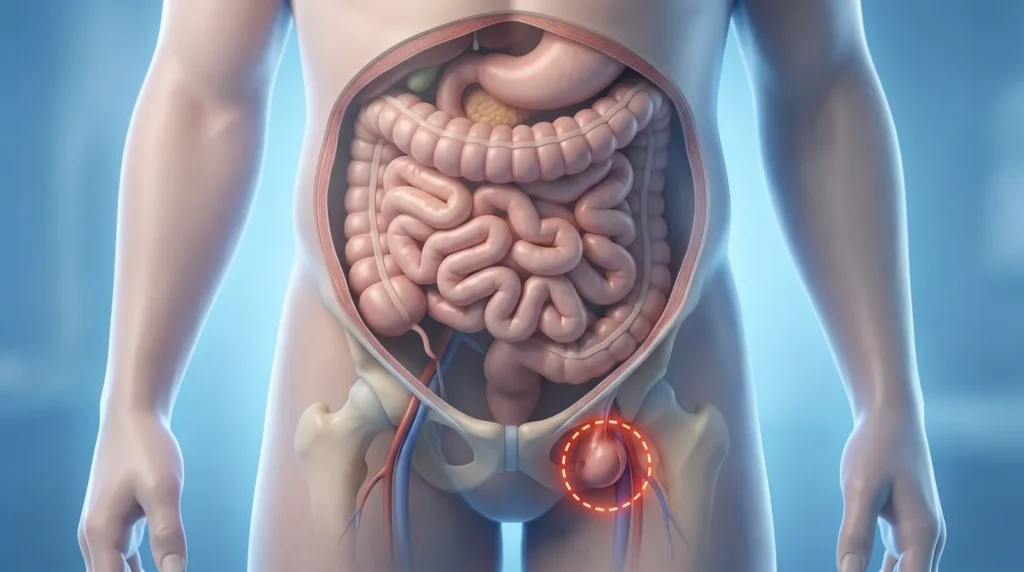
A femoral hernia appears just below the groin crease, at the top of the inner thigh. It is less common than an inguinal hernia and is seen more often in women. Because its opening is narrow, it is more likely to become trapped, so it is usually repaired soon after it is found.
Umbilical hernia
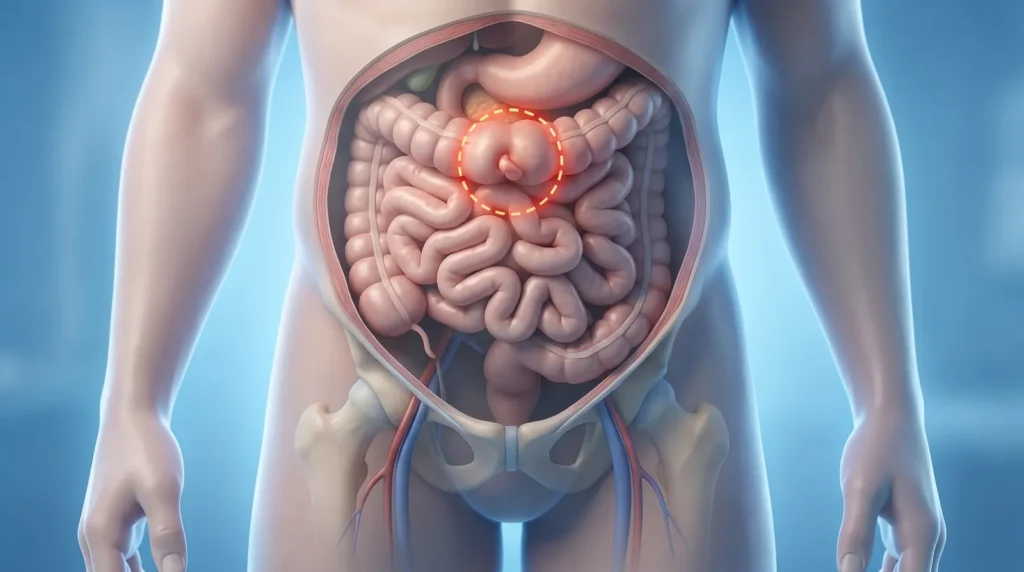
Umbilical hernia symptoms are a bulge at or around the belly button that becomes clearer when you cough or strain; the belly button may look pushed out. It is common after pregnancy and in people carrying extra weight.
Epigastric hernia
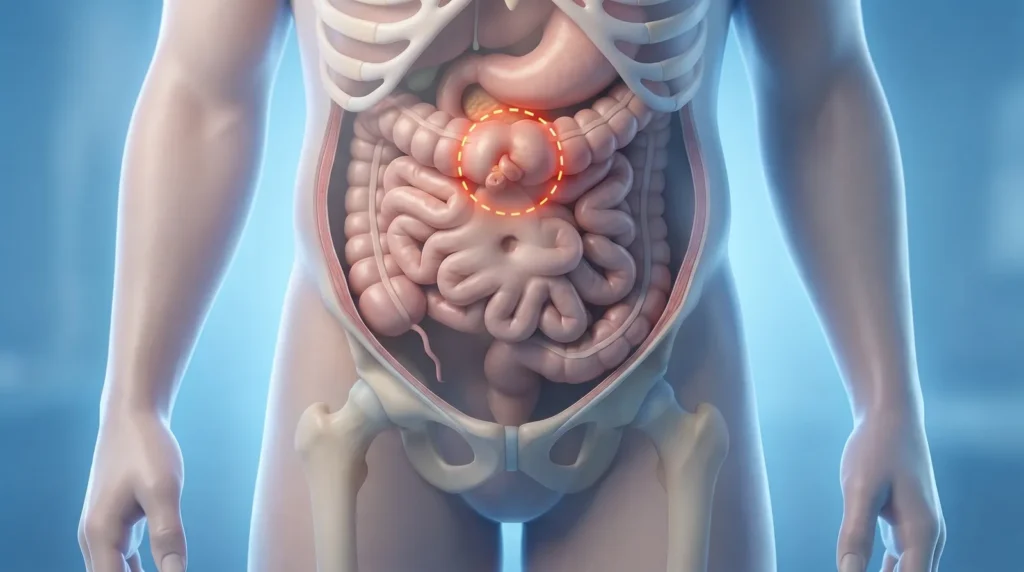
This is a small lump in the middle line of the abdomen, between the belly button and the lower end of the breastbone. It often contains fatty tissue and may be tender, especially after meals or exercise.
Incisional hernia
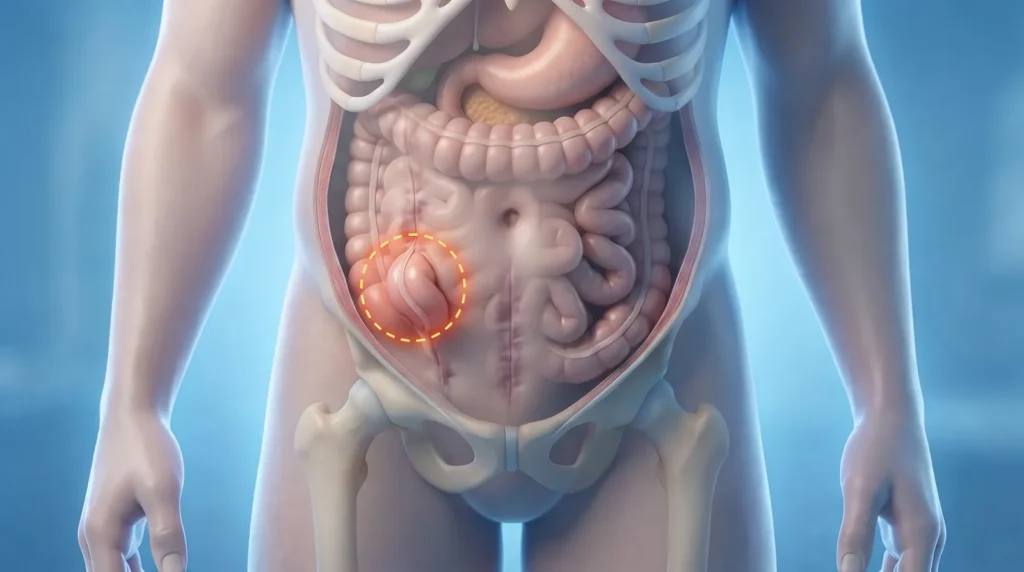
An incisional hernia pushes through the scar of a previous operation, such as a caesarean section or an open abdominal operation. It can appear months or years after surgery and tends to grow with time.
Hiatal hernia
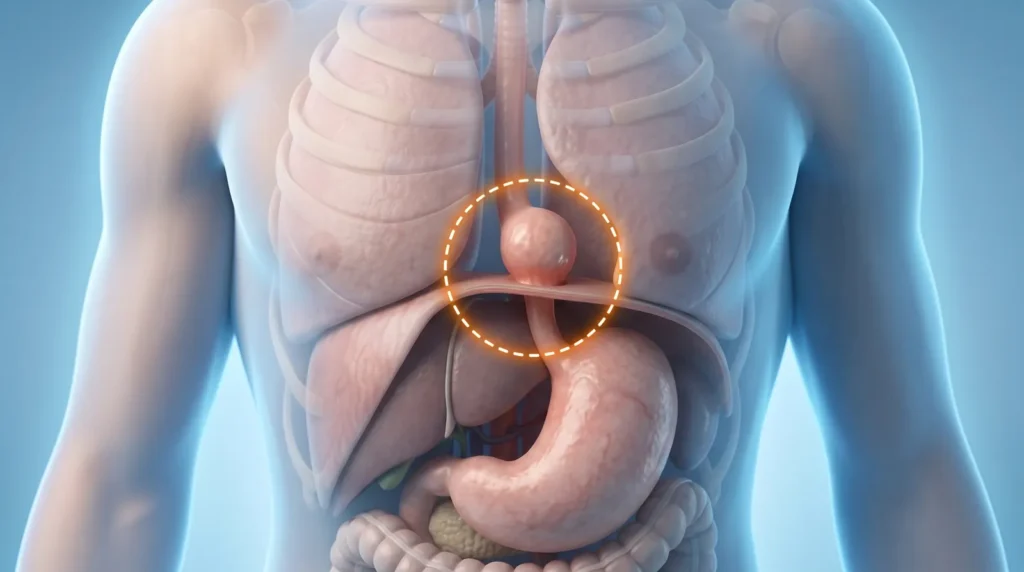
A hiatal hernia is internal: the upper part of the stomach slides up through the opening in the diaphragm (the muscle between the chest and the abdomen). There is no visible bulge. Instead, people notice heartburn, acid reflux, a burning chest, and sometimes difficulty swallowing.
Hernia symptoms in men
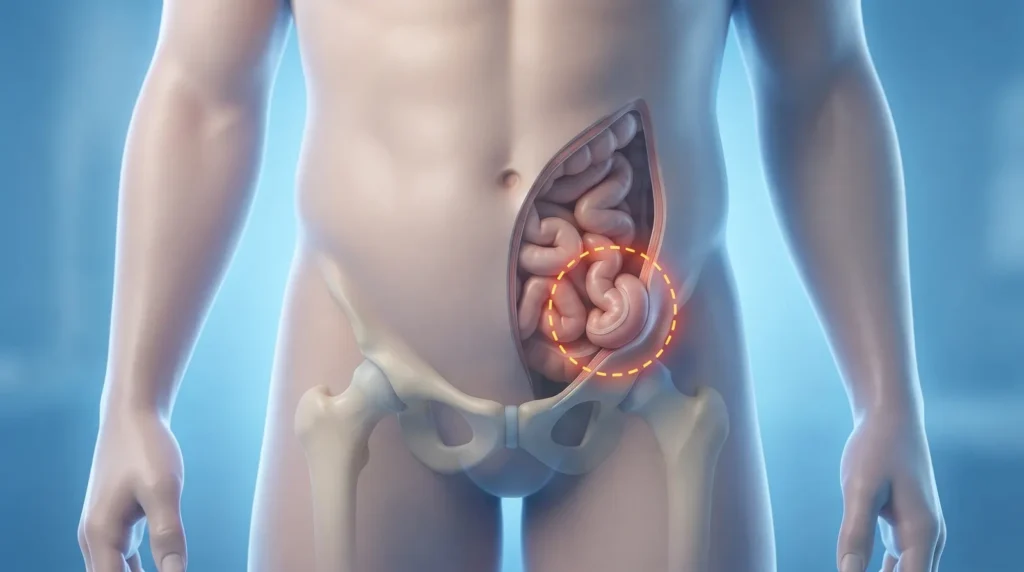
Most hernias in men are inguinal hernias. What men usually notice:
- A soft swelling in the groin on one or both sides, often bigger by the end of the day.
- The bulge gets larger, or you feel a push under your fingers, when you stand, cough, strain or lift something heavy.
- It shrinks or disappears when you lie down, or you can gently push it back.
- An ache, heaviness or burning in the groin, sometimes before any bulge is seen.
When the hernia reaches the scrotum
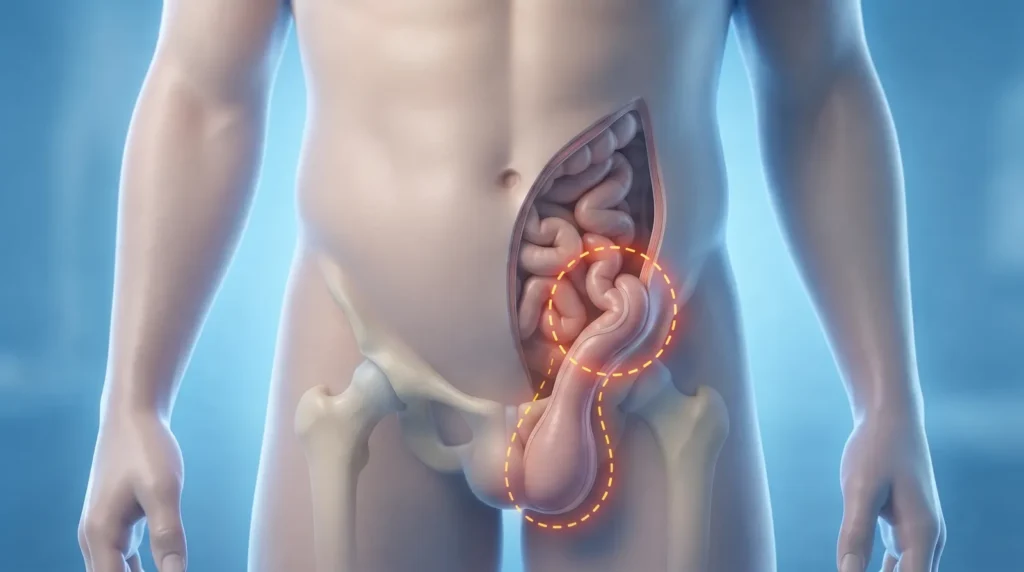
A groin hernia can slide down into the scrotum, so one side looks larger than the other. It can be confused with other scrotal swellings, such as fluid around the testicle (hydrocele) or enlarged veins (varicocele). A surgeon can usually tell the difference by examination, and an ultrasound settles any doubt.
Hernia symptoms in women
Women get inguinal hernias too, but some types are more common in women than in men: femoral hernias, umbilical hernias and incisional hernias after a caesarean section.
Why a groin hernia in women can be missed
In women, groin hernias are often small and lie deeper, so a bulge may not be visible, especially with extra weight. The pain may be mistaken for ovarian or other pelvic pain. If you have groin pain that gets worse with standing or lifting, ask for a surgical examination; an ultrasound is often helpful.
Hernia after a caesarean and in pregnancy
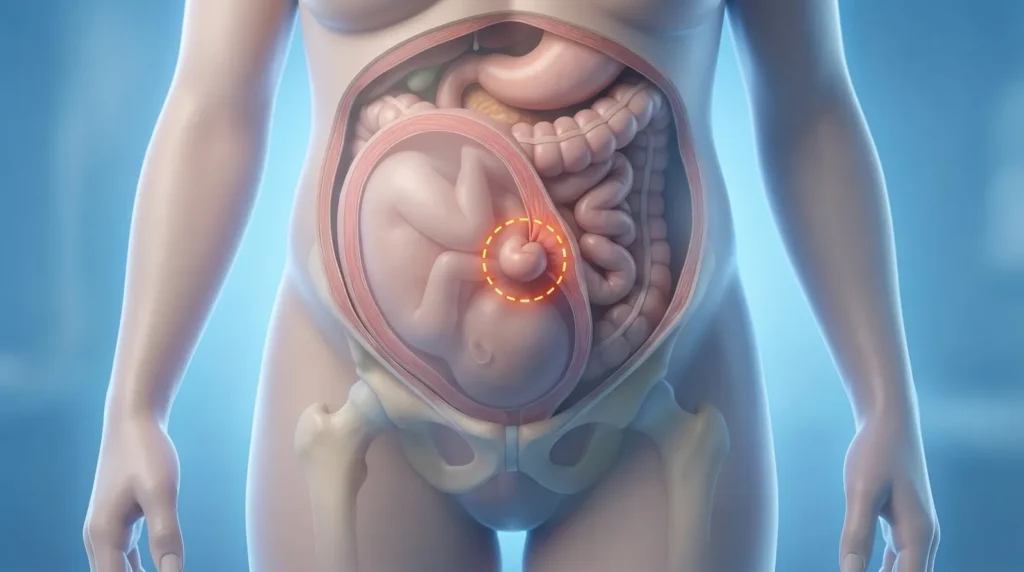
A bulge at or near the caesarean scar may be an incisional hernia. During pregnancy, the growing womb stretches the abdominal wall, so an umbilical hernia may appear or get bigger. A long ridge down the middle of the abdomen is usually separation of the abdominal muscles (diastasis recti), which is not a true hernia. In pregnancy, a hernia without complications is usually watched, and repair is planned after delivery. A hernia that becomes hard or painful during pregnancy needs urgent assessment.
Warning signs: when is a hernia an emergency?
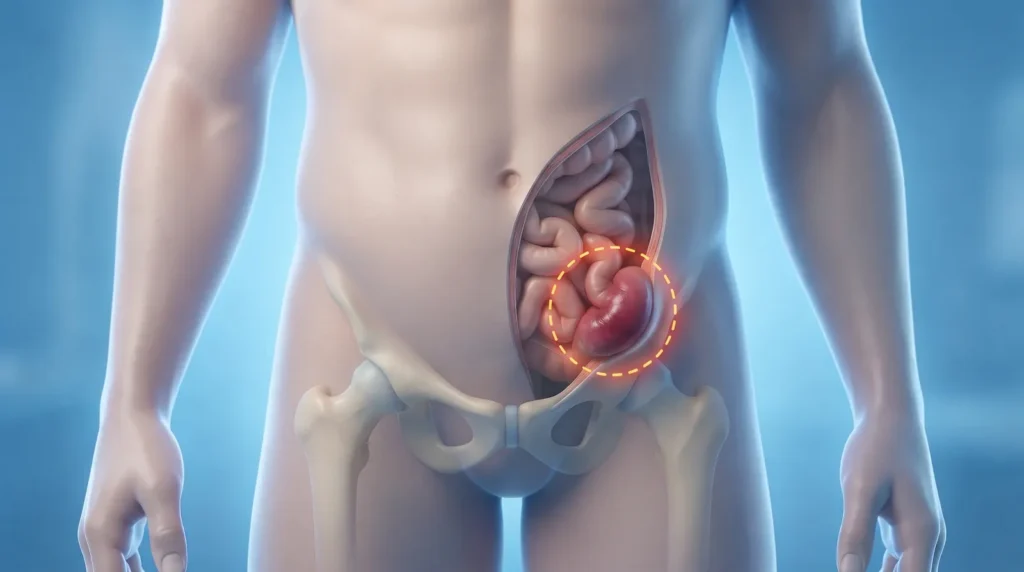
A hernia is trapped (incarcerated) when it can no longer go back in. It is strangulated when its blood supply is cut off, which can damage the bowel within hours. Strangulated hernia symptoms that mean you should go to the emergency room now:
- The bulge suddenly becomes painful, hard, tense or tender.
- It will not go back in, even when you lie down.
- The skin over it turns red, purple or dark.
- Nausea or vomiting.
- You cannot pass wind or open your bowels, or your abdomen swells.
- Fever or feeling generally very unwell.
Do not try to force a painful hernia back in, and do not eat or drink until a doctor has seen you, in case you need surgery.
What causes a hernia?
A hernia needs two things: a weak spot in the abdominal wall and pressure that pushes against it. Some weak spots are natural, such as the groin canal and the belly button; others are made by surgery. Common causes of hernia that raise the pressure include heavy lifting, a long-term cough (often from smoking), straining from constipation or difficulty passing urine, extra weight, and pregnancy. Age and family history also play a part.
Is a hernia dangerous? Can it heal without surgery?
Most hernias are not an emergency on the day they are found, but they do not stay still. In adults, a hernia does not close or heal on its own, and it tends to grow with time. The real risk is that it becomes trapped or strangulated.
- Watching: a small inguinal hernia in a man with few or no symptoms can sometimes be watched safely, after a surgeon has examined it and explained the warning signs.
- Repair: recommended for hernias that cause pain, are getting bigger, are hard to push back, or carry a higher risk, such as femoral hernias.
- Hernia belt (truss): may ease discomfort for some people while they wait or if they are not fit for surgery. It does not cure the hernia and does not prevent strangulation; use one only on your surgeon’s advice.
This article is about adults. Hernias in babies and children are seen by a paediatric surgeon.
How is a hernia diagnosed?
Most hernias are diagnosed by examination. Dr. Ahmed examines you standing and lying down and asks you to cough, to feel the hernia push. An ultrasound helps when the hernia is small, when the diagnosis is unclear (common in women), or with extra weight. A CT scan is used for large or complex scar hernias and in emergencies. A hiatal hernia is diagnosed by upper endoscopy, sometimes with a barium swallow or CT.
Treatment in brief
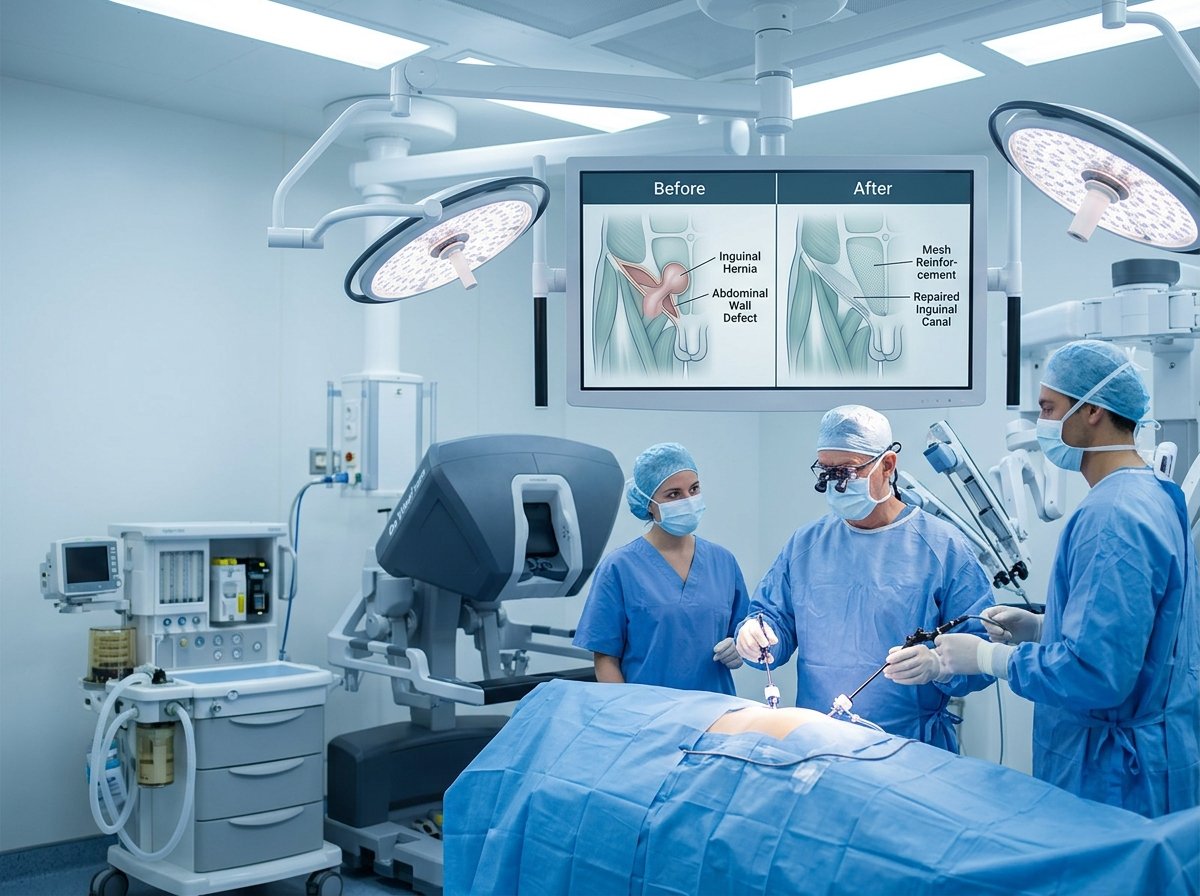
- Groin hernias (inguinal and femoral) are repaired with surgery, usually reinforcing the weak area with mesh, by open or keyhole (laparoscopic) surgery.
- Belly-button and scar hernias are repaired with stitches or mesh depending on their size, by open, laparoscopic or robotic surgery.
- Hiatal hernia is usually treated first with reflux medication and lifestyle changes; laparoscopic surgery is considered when symptoms persist or the hernia is large.
Dr. Ahmed will explain which approach suits you. The cost depends on the individual case and is explained at the consultation.
Frequently asked questions
What does a hernia look like in men?
Usually a soft, rounded bulge in the groin that is bigger when standing or coughing and smaller when lying down. A larger groin hernia can extend into the scrotum and make one side look bigger.
Does a hernia affect erection?
A groin hernia does not usually affect erection directly. Discomfort or a large hernia can make sexual activity uncomfortable. If you have erection problems, tell your doctor, because they usually have other causes that need their own assessment.
What are the symptoms of a hernia?
A bulge that comes and goes, an ache or heaviness that is worse with standing, coughing or lifting, and, with a hiatal hernia, heartburn and reflux instead of a bulge. Sudden pain, hardness, redness or vomiting are warning signs.
How do I know I have a femoral hernia?
A femoral hernia is a small lump just below the groin crease, at the top of the inner thigh, and is more common in women. It is easy to miss, so see a surgeon promptly; an examination, and sometimes an ultrasound, confirms it.
Does a hernia affect fertility?
Most hernias do not affect fertility. A large, long-standing groin hernia can occasionally press on the structures of the testicle on that side. If you are planning a family, tell your surgeon before the repair so it can be taken into account.
Can a hernia come back after surgery?
Yes, a hernia can come back in a small number of patients. Careful repair, keeping a healthy weight, stopping smoking and following the recovery advice on lifting all lower the risk.
If you have noticed a bulge, book a consultation at one of our clinics in Mohandessin, New Cairo or Sheikh Zayed, so Dr. Ahmed can examine it and explain your options.
Related pages
Back to: Inguinal hernia repair
Book your consultation
- Phone and WhatsApp (all clinics): +201000606733 · +201211152111 · WhatsApp
- Clinic hours, 5 to 9 pm: Mohandessin on Sunday and Tuesday · New Cairo on Monday · Sheikh Zayed on Wednesday
- Video consultations are available if you live far away or abroad, and our phone line is open 24/7.
Medically reviewed by Dr. Ahmed Abdelsalam, Associate Professor of General and Laparoscopic Surgery, Kasr Al Ainy, Cairo University, on 13 November 2026.